


Wildlife Habitat Research
Colorado Parks and Wildlife (CPW) is committed to researching better ways to restore and improve wildlife habitat. Many CPW researchers, biologists and managers are actively engaged as wildlife habitat restoration and improvement requires a broad knowledge base. Restoring and improving terrestrial wildlife habitat is critical to ensuring that wildlife has access to the resources — forage, water, shelter — needed to sustain healthy populations. This requires understanding how habitat is being impacted and what methods are most effective in creating a landscape suitable for a variety of wildlife.
Research Projects
Habitat Restoration
When wildlife habitats are disturbed or impacted, active restoration is often needed. Active restoration can include planting seed, modifying the soil, weed management, and other factors.

This work focuses on finding practical ways to restore well pads and pipelines impacted by natural gas development. By utilizing six experiments across an elevation gradient, we identified restoration strategies that work broadly as well as those useful for specific zones.
Using locally collected seed, we successfully established big sagebrush at 12 of 12 research sites spanning an elevation gradient from 5,000 to 9,000 feet. We also found that limiting the amount of competitive grass in seed mixes to as little as 1.5 pounds per acre was helpful in establishing sagebrush. Respreading scraped woody debris hastened shrub recovery by 20% by providing shady microhabitats and entrapping seeds.
A primary focus was overcoming the challenge of cheatgrass, which can rapidly invade disturbed rangelands. We found that successful control required a tailored approach. By matching techniques to specific elevation zones, managers can ensure that disturbances are returned to functional, diverse habitats that support long-term wildlife health.

Our research highlights how strategically sized soil pits—large enough to be durable but small enough for easy implementation—can concentrate moisture to significantly improve native plant establishment in arid environments. Beyond water conservation, our research found a powerful second benefit: weed control. By creating physical obstructions on the soil surface, pits interrupt the seed dispersal of invasive annuals like cheatgrass, trapping their seeds and forcing them into intense intraspecific competition that reduces their overall seed production.
As our climate becomes hotter and more variable, these types of low-cost, surface-modifying techniques will be essential tools for land managers. Our findings from sites across Colorado concur with those from other areas: pit seeding is a highly effective strategy for restoring resilience to our most vulnerable arid habitats. For more information, please see our publication.

Choosing the right seeds for a restoration project can be a daunting task. We developed a tool to make it easier for Colorado lands. Our tool combines the expert knowledge of our staff, other Colorado practitioners, and published research. It is a mobile app available by searching for ‘Colorado Seed Tool’ from either the App store or Google Play store on your smartphone. To use it, you need only to know your county, elevation and management goals. Available management goals include deer habitat, pollinator habitat, erosion control, and others.

Bitterbrush and mountain mahogany are upland shrubs which provide key wildlife forage in Colorado. Due to fire, invasive weeds, and climate change, these shrubs have declined in some areas of the state. Restoring them can be challenging because multiple stressors limit their establishment. These include weed competition, rodent seed predation, and insect herbivory, among others.
We wanted to know which of these factors- weeds, rodents, or insects- caused the most damage to seedlings. We investigated this at 5 locations around the state, and have found that rodents most commonly have the biggest impact. This result will help managers establish these species more effectively, and help guide future research.
Plant and Animal Interactions
Wildlife and their habitats influence each other in a reciprocal way. This interaction can be influenced by management actions such as habitat modification or species reintroduction.
Comparing Mechanical Treatments for Pinyon-juniper Removal
Managers sometimes desire to reduce woody plant cover, in order to reduce fuel loads and/or improve wildlife habitat. We investigated three different ways to do this:
- Ship Anchor Chaining - This is the oldest method and entails dragging a ship anchor chain between two bulldozers in order to pull over and uproot trees. This is generally the least expensive method, although it causes soil disturbance and large tree skeletons remain behind after treatments.
- Roller Chopping – This method entails dragging a rotating drum with protruding plates behind a bulldozer. Trees are knocked over by the bulldozer and chopped into pieces by the rotating drum.
- Mastication - This is the most recent and expensive method. It uses a rubber-tired loader with a mulching head to grind trees into a fine mulch. This method causes the least amount of soil disturbance of the three described here.
By six years post treatment, vegetation did not differ greatly among these three methods. However, we found that mule deer did respond differently to them. Specifically, we found that roller-chopped and chained plots saw approximately 70% higher winter mule deer use compared to untreated areas. We attribute this to the presence of large woody debris, which provides vital security cover and may even hasten snowmelt to reveal understory forage. In contrast, masticated plots—which mulch trees to ground level—received high use during the summer but were utilized much less in winter, likely due to the lack of vertical structure and vertical cover.


Community Effects of Predator Reintroduction
Predators sometimes cause changes in habitats by altering herbivore browsing pressure. Predators may cause herbivores to leave preferred foraging areas, or they may reduce the overall number of herbivores. Alternatively, changes may not be evident, as complex ecosystems are buffered by numerous species interactions and herbivores may display flexible foraging behavior. We are in the process of setting up a long-term study to investigate potential changes in browsing pressure due to wolf reintroduction. Our study is initially focused on vegetation within deer and elk winter ranges in Middle Park and Upper Colorado River Valley areas of Colorado.
Nutritional Ecology
Nutritional ecology is the science of relating an animal to its environment through nutritional interactions. Wildlife habitat research incorporating nutritional ecology requires knowledge of the nutritional requirements (energy and protein) and foraging behavior (what plants and plant parts do they consume) of the animal of interest. This information is then used to document changes in the quality and quantity of forage available on the landscape, accounting for the seasonal differences in forage availability and selection.
Estimating nutritional forage biomass for three elk herds in western Colorado
Colorado Parks and Wildlife has conducted long-term research to evaluate factors influencing recruitment and the impacts of recreation on elk herds in western Colorado. Differences in body fat of adult cows in late winter, body mass of calves (newborn and 6-month-old), and survival of calves have been detected between the herds. Differences in body condition between these elk herds suggest there may be nutritional limitations occurring on the landscape, which may be a function of available forage biomass and/or forage quality. Furthermore, differences in elk calf survival between the herds could be influenced by summer forage quality and vegetation concealment cover during late May and June.
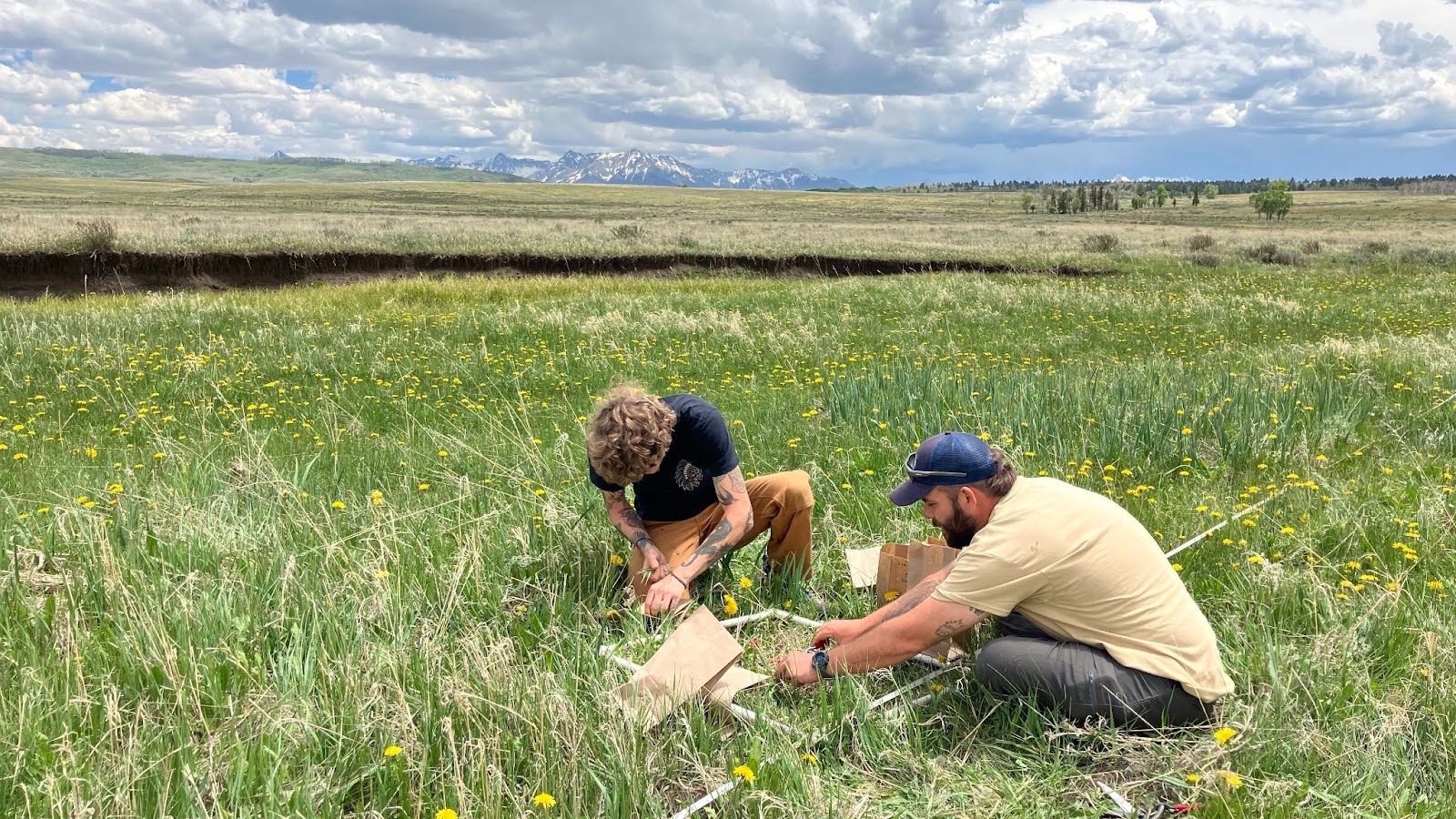
Within each study area, we completed vegetation transects in dominant vegetation cover types within elk summer home ranges. At each sampling location, we clipped preferred elk summer forage species from quadrats, which we then dried to determine available biomass and analyzed for nutritional quality (digestibility, protein). Additionally, at each sampling location, we collected foliar cover, canopy cover, and horizontal concealment cover.
Meet the Research Team
Wildlife habitat research scientists are part of the CPW Avian Research team; however, they collaborate with a variety of CPW researchers and staff to conduct habitat research on terrestrial wildlife species across the state. Wildlife habitat research scientists also serve on various committees and working groups with other partners (state, federal, and local governments, and non-governmental organizations) in wildlife habitat research and conservation.

Danielle Bilyeu Johnston
Wildlife Habitat Research Scientist
Areas of Interest/Expertise include:
Seed mix design and seeding techniques
Invasive species management
Plant-animal interactions, particularly ungulate herbivory
Upland shrub restoration
Wildlife habitat and rangeland improvement techniques

Daniel P Thompson
Wildlife Habitat Research Scientist
My research interests incorporate nutritional ecology into wildlife habitat management and research programs. My research focuses on landscape-scale terrestrial wildlife habitat by evaluating the spatiotemporal changes in vegetation, and the implications for the wildlife species of interest.